


In your research into shredding security, you’ll have come across terms like P-levels, micro-cut and cross-cut. Maybe you’ve scoured Reddit threads trying to work out whether cross-cut is enough. But there’s something many guides don’t tell you.
Once you start handling larger volumes, using a high-security shredder yourself regularly goes awry.
Machines eventually do what they do best — they jam. Or they overheat. They slow you down and frustrate you, and when that happens, security slips.
Use this guide to understand paper shredder security levels clearly, and more importantly, when it makes sense to stop DIY shredding and move to certified secure destruction.
Understanding Paper Shredder Security Levels (DIN 66399 / ISO 21964)
If you’ve seen “P-4,” “P-5,” or “P-7” in your research, you’re looking at the DIN 66399 (also aligned with ISO 21964) security standard.
DIN 66399 and ISO 21964 define how small a document must be shredded to be considered secure. It’s not about descriptive labels like “cross-cut,” but measurable particle size (and therefore real-world risk).
Let’s take a closer look at what security level is right for you.
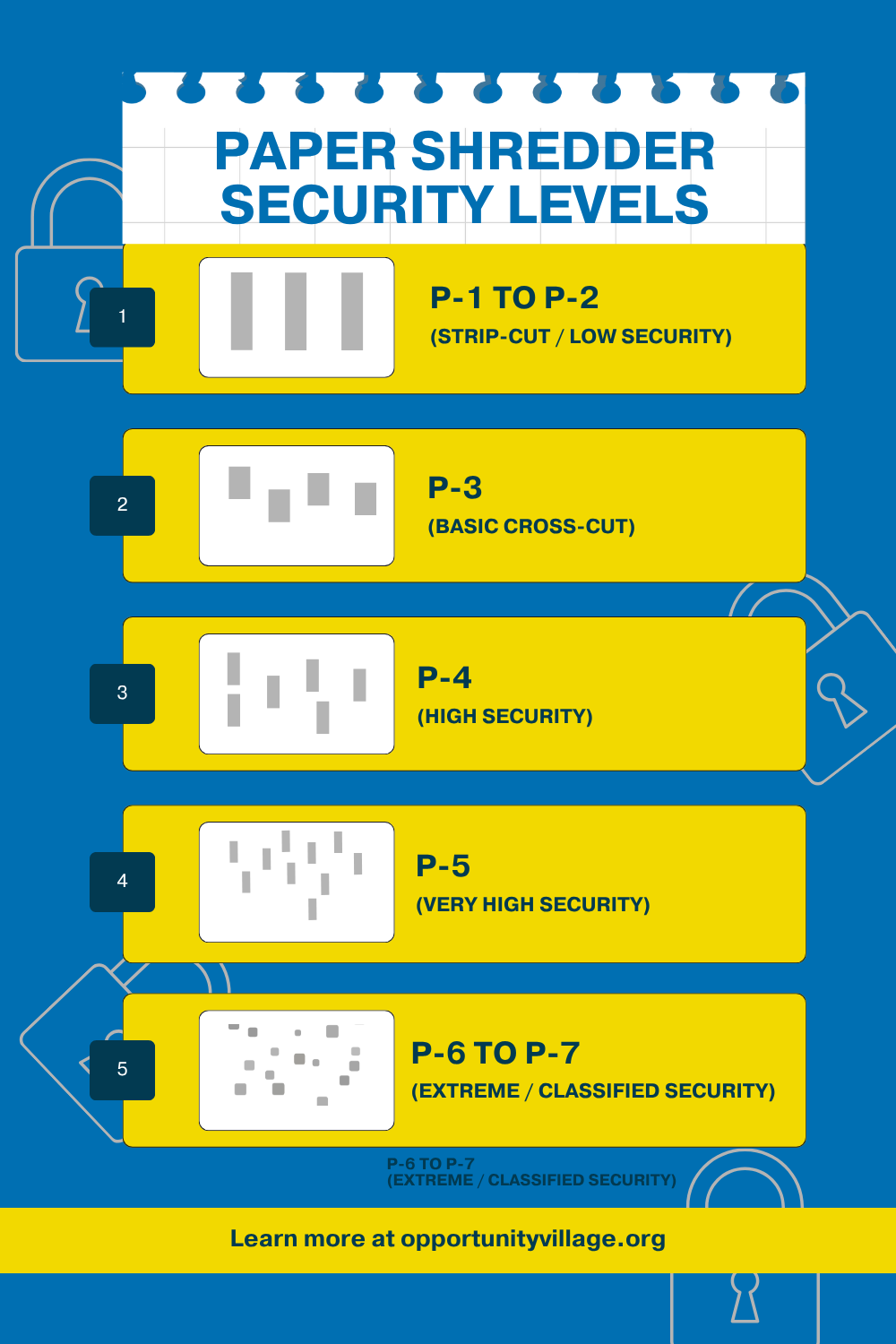
P-1 to P-2 (strip-cut / low security)
This creates long strips, often several millimeters wide. Documents are still clearly readable in parts and can be reconstructed with minimal effort.
P-3 (basic cross-cut)
P-3 shredding creates smaller rectangular pieces, but they’re still large enough that somebody could reconstruct them. This is where many home-office shredders sit and it feels more secure, but for sensitive data, it isn’t enough.
P-4 (high security – practical baseline for sensitive data)
P-4 particles are significantly smaller (typically under 160 mm²). At this level, reconstruction becomes difficult and time-consuming.
P-4 is widely treated as a practical minimum for handling personally identifiable information (PII), including employee records, client files, and financial documents. It aligns with the level of destruction expected when working under privacy frameworks like GDPR or handling regulated data under laws such as HIPAA.
P-5 (very high security – the tipping point)
P-5 creates even smaller particles (typically under 30 mm²). At this level, documents are reduced to fragments that are extremely difficult to reassemble in any meaningful way.
This is the tipping point where security moves from “generally safe” to “defensively secure.” Organizations handling highly sensitive financial, legal, or medical information often aim for this level to reduce reconstruction risk as much as possible.
P-6 to P-7 (extreme / classified security)
Now you’re looking at micro-cut shredding at its most extreme. P-7, in particular, is used for top-secret or classified information and is the only level of security approved for use by the National Security Agency (NSA) and the Central Security Service (CSS).
Particle sizes are tiny (often less than 5 mm²). This level is designed for military, intelligence, and government use. Achieving and maintaining this level consistently with a home or office machine is virtually impossible, both technically and operationally.
So where does that leave you?
If your documents include anything that could expose personal identities, financial data, or confidential business information, lower paper shredder security levels simply don’t hold up.
If you’re unsure where your documents sit, consider what to shred based on the sensitivity of the information you handle — the level you choose should always match the consequences of getting it wrong.
Why “Cross-Cut” Isn’t Enough
A shredder might say “cross-cut” and it might even claim a higher security level. But real-world use is where things break down.
First, there’s the reconstruction risk. Lower-level shred output (especially strip-cut or basic cross-cut) can still be pieced back together. Yes, it takes effort, but it’s possible. And if the information is valuable enough? Well, that effort becomes worthwhile.
Then there’s the human factor. Anyone who has used a home or office shredder knows the routine:
- feed a few sheets
- wait
- clear a jam
- empty the bin
- repeat
It doesn’t take long before frustration sets in, does it? And when it does, even the best of us risk cutting corners. Documents get set aside “for later.” Or worse, they end up in general recycling without being destroyed at all.
Here, your choice of technology has created a problem with your business process, which leads to potential security breaches.
And finally, there’s something most people don’t think about: proof.
A home shredder doesn’t give you a Certificate of Destruction. It doesn’t provide a documented chain of custody. If you ever need to show that sensitive information was handled properly, there’s no audit trail to rely on.
The True Cost of P-5+ Shredders
At this point, many people double down, thinking if they just buy a better shredder, that’ll fix the problem.
On paper, that makes sense. But in practice it creates a new set of issues. Start with cost. High-security shredders capable of consistent P-5 or higher performance can run into the thousands (up to $6000). And that’s just the upfront price.
Then there’s maintenance. These machines need regular oiling, and blades will wear down. Motors overheat. And when something goes wrong, repairs aren’t simple (read: they’ll make a hefty dent in your bottom line).
Even still, the highest cost most people overlook is time. Imagine your highly-skilled (and highly paid) employee standing next to a shredder, feeding stacks of paper, waiting for cycles to finish, clearing jams, and managing output.
That’s time you’re paying for being spent on a task that doesn’t move your business forward.
If you’re weighing this decision, consider how much it costs to shred documents using a managed service versus handling everything in-house with your own machinery.
Once you factor in equipment, maintenance, and labor, you’ll find the “cheaper” DIY option usually isn’t cheaper at all.
Don’t pay more just to risk a data breach with a jammed home shredder. Rely on PII-compliant destruction from a professional shredding service — get a quote today and shred with confidence.
Secure for You, Opportunity for Our Community
Instead of trying to replicate high-security destruction in an office environment, you can hand the process over to professionals and a system built for it.
Paper Pros, a division of Opportunity Village, provides secure document destruction designed for real-world volume and real-world risk.
That means:
- controlled handling of materials
- secure processes from collection to destruction
- industrial-grade shredding that renders documents unreadable
- and documented proof that the job was done properly
But there’s another layer that matters just as much.
Now recognized as a national leader, Opportunity Village has been part of the Southern Nevada community since 1954, creating pathways for people with intellectual and developmental disabilities to build skills, find employment, and participate fully in community life.
When you choose secure shredding through Paper Pros, you’re protecting your information first and foremost. But you’re also helping create meaningful work and opportunities for people who are often excluded from traditional employment pathways.
That’s a combination you can feel good about: high-level security and real, visible community impact.
Don’t risk a data breach with a jammed DIY shredder. Get PII-compliant document destruction that supports your community.
When Your Security Standard Meets Our Mission
By now, you’ve probably realized something important. This isn’t really about choosing between a P-4 or a P-5 machine, but about how confident you want to be that your information is truly secure (even when something goes wrong). Paper shredder security levels are a useful guide. They help you understand what level of destruction is needed.
But they don’t solve the bigger problem — once you’re dealing with sensitive information at any real scale, security becomes less about the machine, and more about the process behind it.
That’s where professional shredding changes the equation. And when your security standard meets a mission built on opportunity, everyone wins.
Explore how Opportunity Village provides secure destruction and inclusive opportunity through Paper Pros.